Urban Adda 2026
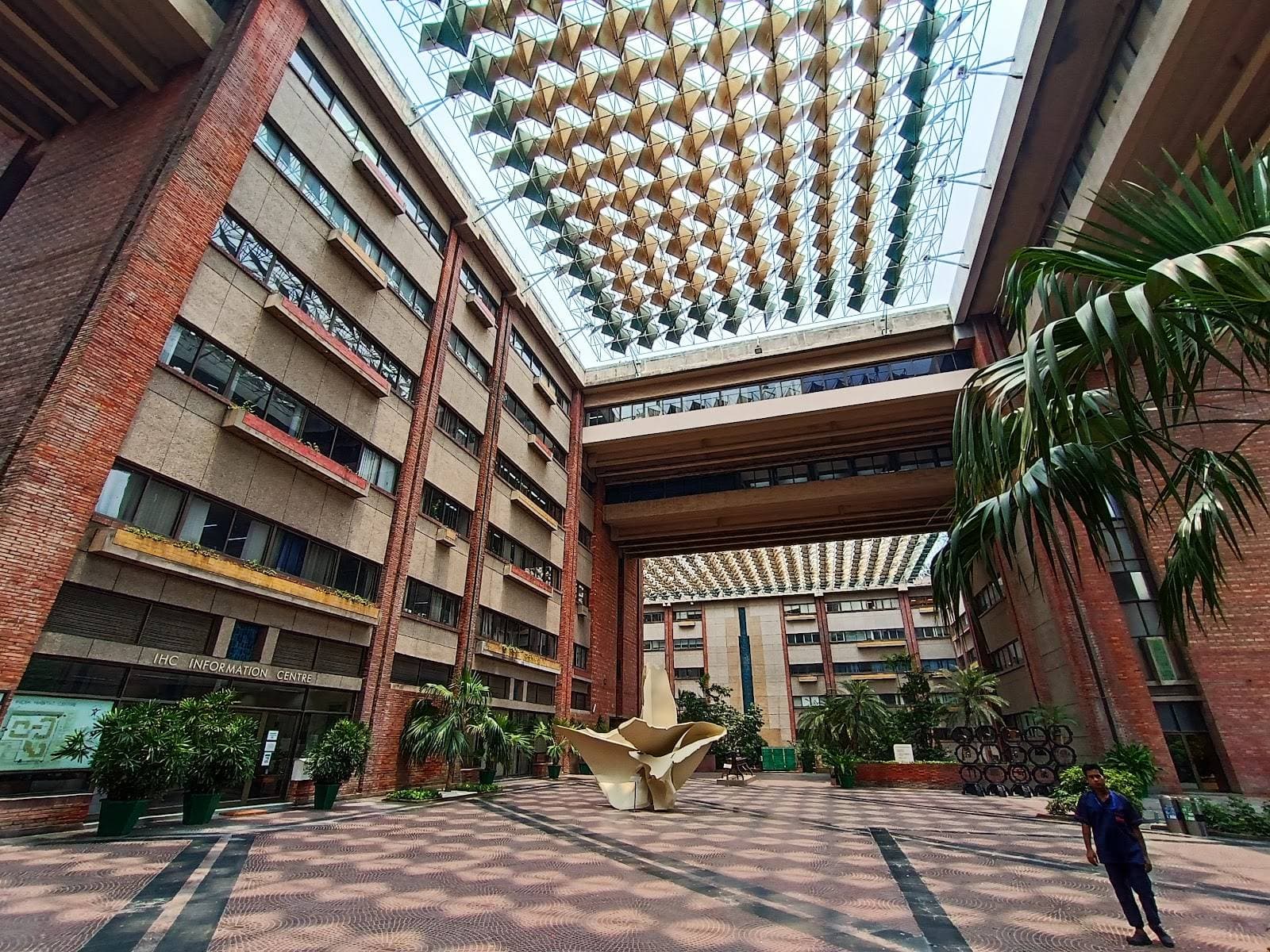
5th–7th October 2026 · India Habitat Centre, New Delhi
One Adda for Change
Building Sustainable, Inclusive and Resilient Cities — three days of dialogue, knowledge exchange and collective action, with GuruJal bringing water security to the heart of the urban agenda.
- Dates
- 5–7 Oct 2026
- Venue
- India Habitat Centre
- Duration
- 3-Day Gathering
- Theme
- One Adda for Change
About the event
Urban Adda 2026 — Reimagining the Future of Indian Cities
- 3Days
- 4GuruJal sessions
- 2Publications launched
- 1Water Citizens' Council convened
Urban Adda 2026 brought together policymakers, urban planners, researchers, environmental practitioners, industry leaders, civil society organisations, young professionals and citizens to reimagine the future of Indian cities. Held from 5–7 October 2026 at India Habitat Centre, New Delhi, the three-day gathering created a collaborative platform for dialogue, knowledge exchange and collective action under the theme “One Adda for Change.” Through panel discussions, workshops, exhibitions, interactive experiences and networking, the event explored interconnected urban challenges — water security, climate resilience, sustainable mobility, air quality, inclusive infrastructure, ecological restoration and citizen participation.
Co-hosted by GuruJal, Urban Adda 2026 reinforced the importance of connecting policy with practice and scientific knowledge with community action. For GuruJal, it was a chance to bring water security into wider conversations on sustainable urban development — highlighting how nature-based solutions, circular water management, responsible infrastructure planning and citizen-led governance can strengthen urban resilience. Urban Adda demonstrated the value of collaboration: bringing diverse stakeholders together to share experiences, question conventional approaches and chart pathways towards more liveable, equitable and water-secure cities.
GuruJal's role
From Conversations to Collective Water Action
At Urban Adda 2026, GuruJal contributed to discussions on some of the most pressing challenges shaping India's water future. Through four focused sessions, knowledge-sharing initiatives and interactive engagements, GuruJal highlighted the need to move beyond fragmented interventions towards integrated, scalable and community-driven solutions.
Restoring natural water systems
How Indian cities can bring back the lakes, wetlands and drainage that once carried their water.
Circular water management
Moving from linear use to conservation, treatment, reuse and recharge.
Infrastructure meets availability
Balancing emerging infrastructure demands, such as data centres, with the water that is actually available.
Citizen participation in governance
Strengthening the role of citizens in how water is protected and managed.
Key sessions and conversations
Four Sessions Led by GuruJal
- Day 1 · 5 October 2026 · Jacaranda Hall01
Towards Water-Secure India: Walking the Talk
Theme: From Solutions to Scalable Action
India has no shortage of research, technologies or successful water conservation initiatives. The challenge lies in translating these solutions into widespread, long-term action.
Moderated by Dr. Fawzia Tarannum, Co-Founder and Strategic Advisor, GuruJal, the discussion brought together experts from the National Institute of Urban Affairs (NIUA), INTACH, the Council on Energy, Environment and Water (CEEW), S M Sehgal Foundation and Development Alternatives. The panel examined how natural hydrology, urban planning, community ownership and institutional collaboration can work together to strengthen water security.
Key takeaways
- Integrate natural drainage patterns and hydrological systems into urban planning.
- Recognise communities as active stakeholders rather than passive beneficiaries.
- Strengthen collaboration between government institutions, researchers and local communities.
- Scale proven, nature-based water solutions through better governance and implementation.
Knowledge product launch: GuruJal launched its case study, “India's First Water-Neutral Campus – BSF Campus, Bhondsi, Gurugram,” documenting an integrated approach to rainwater harvesting, wastewater treatment, reuse and groundwater recharge.
- Day 2 · 6 October 2026 · Jacaranda Hall02
Circularity for Water Security: Closing the Loop – Reuse, Recharge and Restore
The session explored how cities can move away from linear water consumption towards a circular approach that prioritises conservation, treatment, reuse, recharge and ecological restoration.
Moderated by Shubhi Kesarwani, Co-Founder and CEO, GuruJal, the plenary featured Dr. Satbir Singh Kadian, Dr. Ranjana Ray Chaudhuri, Savita Bhandari, Vandana Menon and Kamal Kant Sehgal. Discussions highlighted the interconnected challenges of urban water scarcity and flooding, the importance of watershed-level planning, and the need for water-sensitive urban development.
Key takeaways
- Address urban water scarcity and flooding as interconnected challenges.
- Promote rainwater harvesting, decentralised storage and groundwater recharge.
- Prioritise treated wastewater reuse and circular water management.
- Integrate wetlands, lakes and blue-green infrastructure into urban development.
- Strengthen water accounting, regulation and long-term maintenance.
Publication launch: the session also marked the launch of GuruJal's coffee-table book, “Reconnecting Nature, Reconnecting Lives,” documenting seven years of waterbody restoration, ecological transformation and community-led water stewardship.
- Day 2 · 6 October 2026 · Willow Hall03
Data Centres and Water: People, Policy and Planning
In collaboration with the All Ivy+ Network
As India's digital infrastructure and artificial intelligence ecosystem expand, the water requirements of data centres are becoming an increasingly important urban sustainability concern.
Moderated by Ashish Dev Kapur, Vice-Chairman, Abhipsa Foundation, and Advisory Board Member, GuruJal, the session featured Alok Lall, Anshuman, Sangeetha Raghuram, Shubhankar Chaudhry and Rupamanjari Sinha Ray. The discussion examined the direct and indirect water footprint of data centres — including cooling, electricity generation and semiconductor manufacturing — alongside responsible siting, transparent water accounting and water-efficient technologies.
Key takeaways
- Consider local water availability and watershed carrying capacity before approving data-centre projects.
- Measure, meter and audit water consumption.
- Encourage transparent reporting and disclosure of water use.
- Prioritise treated wastewater reuse and water-efficient cooling technologies.
- Integrate community needs and ecological considerations into infrastructure planning.
The session concluded with an interactive Mentimeter workshop, where participants contributed ideas towards the priorities of the Alliance for Responsible Data Centres, an industry coalition convened by the All Ivy+ Network to promote responsible and resilient AI infrastructure.
- Day 3 · 7 October 2026 · NIUA Conference Hall04
Water Citizens' Council – Delhi NCR Chapter
In collaboration with NIUA · Building a Citizen-Led Platform for Collaborative Water Governance
On the final day of Urban Adda 2026, GuruJal and the National Institute of Urban Affairs (NIUA) convened the founding meeting of the Water Citizens' Council – Delhi NCR Chapter.
Moderated by Dr. Fawzia Tarannum, the meeting brought together researchers, environmental practitioners, civil society representatives, founders and concerned citizens to explore how citizens can play a stronger role in protecting and managing water resources. The session focused on developing a collaborative, citizen-led platform to promote water literacy, conservation, accountability and meaningful engagement with government institutions. Through facilitated group discussions, participants contributed to the Council's draft charter — its purpose, citizen authority, organisational structure, first-year priorities and safeguards for independence.
Key takeaways
- Build a citizen-led network for water awareness and collective action.
- Strengthen public participation and accountability in water governance.
- Create opportunities for knowledge-sharing between citizens, researchers and institutions.
- Identify practical priorities and collaborative initiatives for the Delhi-NCR region.
- Develop a transparent, inclusive and evidence-based framework for long-term engagement.
The meeting marked an important first step towards building a community of informed and engaged citizens committed to a water-secure Delhi-NCR.
Knowledge and publications launched
Two publications, launched at Urban Adda
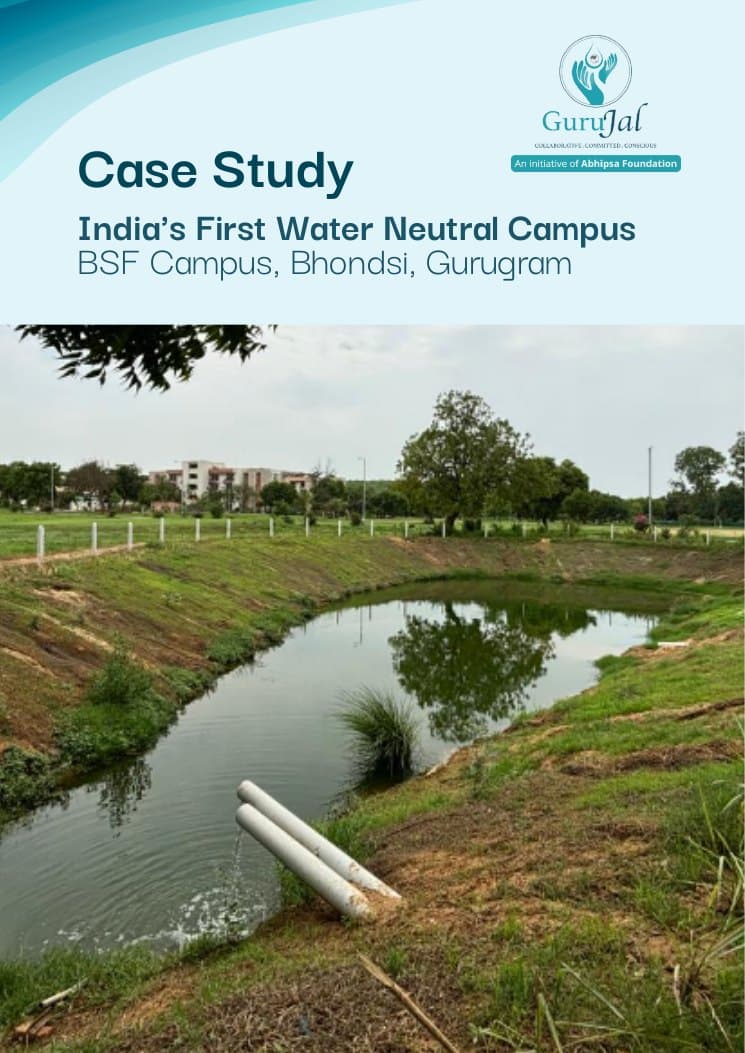
India's First Water-Neutral Campus
BSF Campus, Bhondsi, Gurugram — Case study
This case study documents GuruJal's integrated water-management interventions at the BSF Bhondsi Campus, including wastewater treatment and reuse, rainwater harvesting, groundwater recharge and nature-based solutions.
The publication presents a practical example of how large institutional campuses can work towards water neutrality through integrated planning and long-term water stewardship.
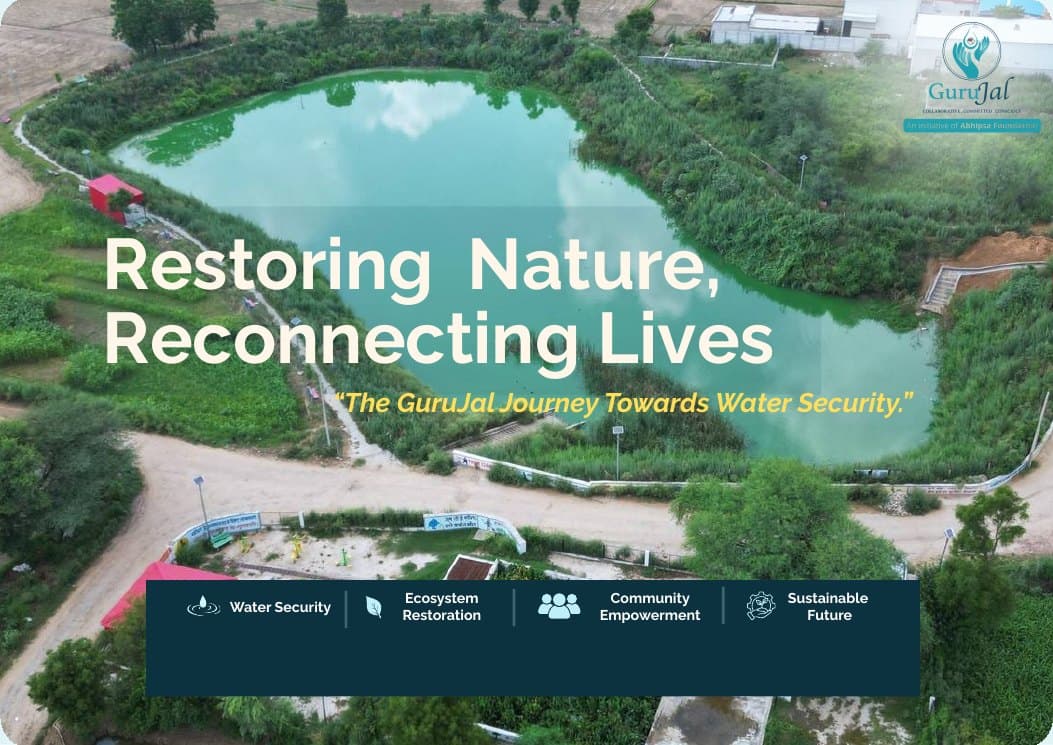
Reconnecting Nature, Reconnecting Lives
Seven Years of Water Restoration and Community Stewardship — Coffee-table book
GuruJal's coffee-table book captures the organisation's journey of restoring degraded waterbodies, reviving ecological spaces and reconnecting communities with their natural water resources.
Through project stories, photographs and documented interventions, the publication highlights the role of nature-based solutions, community participation and long-term maintenance in creating sustainable water systems.
Know Your Water
Connecting citizens with water literacy
Alongside the panel discussions, GuruJal engaged visitors through its “Know Your Water” initiative in the exhibition area.
The interactive stall encouraged visitors to understand the water they use, explore basic water-quality parameters and recognise the importance of water conservation and responsible water management.
Through educational demonstrations and conversations, the initiative made water literacy accessible to a wider audience, particularly students, young professionals and citizens.
Key learnings
What the Conversations Taught Us
- 01
Work with natural hydrology
Integrate natural drainage patterns, wetlands, lakes and blue-green infrastructure into how cities are planned and built.
- 02
Close the water loop
Treat scarcity and flooding as linked problems, and prioritise rainwater harvesting, recharge and treated-wastewater reuse.
- 03
Measure and disclose water use
Meter, audit and transparently report water consumption — and weigh local availability before approving water-intensive infrastructure such as data centres.
- 04
Put citizens at the centre
Recognise communities as active stakeholders, and build citizen-led platforms for accountability and collaboration in water governance.
Outcomes & collaborations
Beyond the Sessions: Collaboration for Sustainable Cities
Knowledge shared
A case study on India's first water-neutral campus and a coffee-table book on seven years of restoration were launched.
A citizen-led platform begun
The founding meeting of the Water Citizens' Council – Delhi NCR Chapter drafted its charter with researchers, practitioners and citizens.
Water in the urban agenda
Nature-based solutions, circular water management, responsible infrastructure planning and citizen-led governance entered wider conversations on sustainable cities.
Relationships built
Organisations, researchers, policymakers, industry representatives and citizens exchanged knowledge and explored collaborative solutions.
Collaboration & partnership
Hosts & Partners
Host
Co-host
Co-host

Co-host
Session partner
Session partner
What's next
The event may have concluded — the conversations continue
An Adda is a place where people come together — not only to discuss challenges, but to collaborate, support one another and collectively build the cities they hope to see. GuruJal remains committed to integrated water management, ecological restoration, community stewardship and collaborative governance. Together, towards sustainable cities and a water-secure future.