BSF Bhondsi Pond — From Sewage Hazard to Community Sanctuary
Inside the 95 BSF campus at Bhondsi, a 0.5-acre pond and a 50 KLD Anaerobic Baffled Reactor convert chronic sewage waterlogging into a thriving community oasis — for 116 families and 28 species of local wildlife.
- 0.5acresPond area with protective buffer
- 50KLDABR wastewater treatment plant
- 116Families relieved of waterlogging
- 28Native fauna species recorded
- 7Native plant species established
- 12stagesConstruction process
Background
Restoration challenges in a high-density institutional campus
Ponds face restoration challenges across global and Indian landscapes. Despite their ecological importance, ponds have been steadily deprioritised in urban and institutional planning — limited financial resources, institutional constraints and unchecked urbanisation have worsened their condition, creating both environmental degradation and concrete health concerns.
The 95 BSF campus at Bhondsi is a working illustration of the problem. Across the campus, sewage pooled around a manhole, a 50 KLD treatment plant sat defunct, and roughly 116 families lived with the daily consequences of waterlogging.
GuruJal's intervention reframed the site: convert the environmental hazard into a community asset. Build a resilient pond and a working treatment system, foster groundwater recharge, and turn the surrounding ground into a recreation sanctuary residents actually want to spend time around.
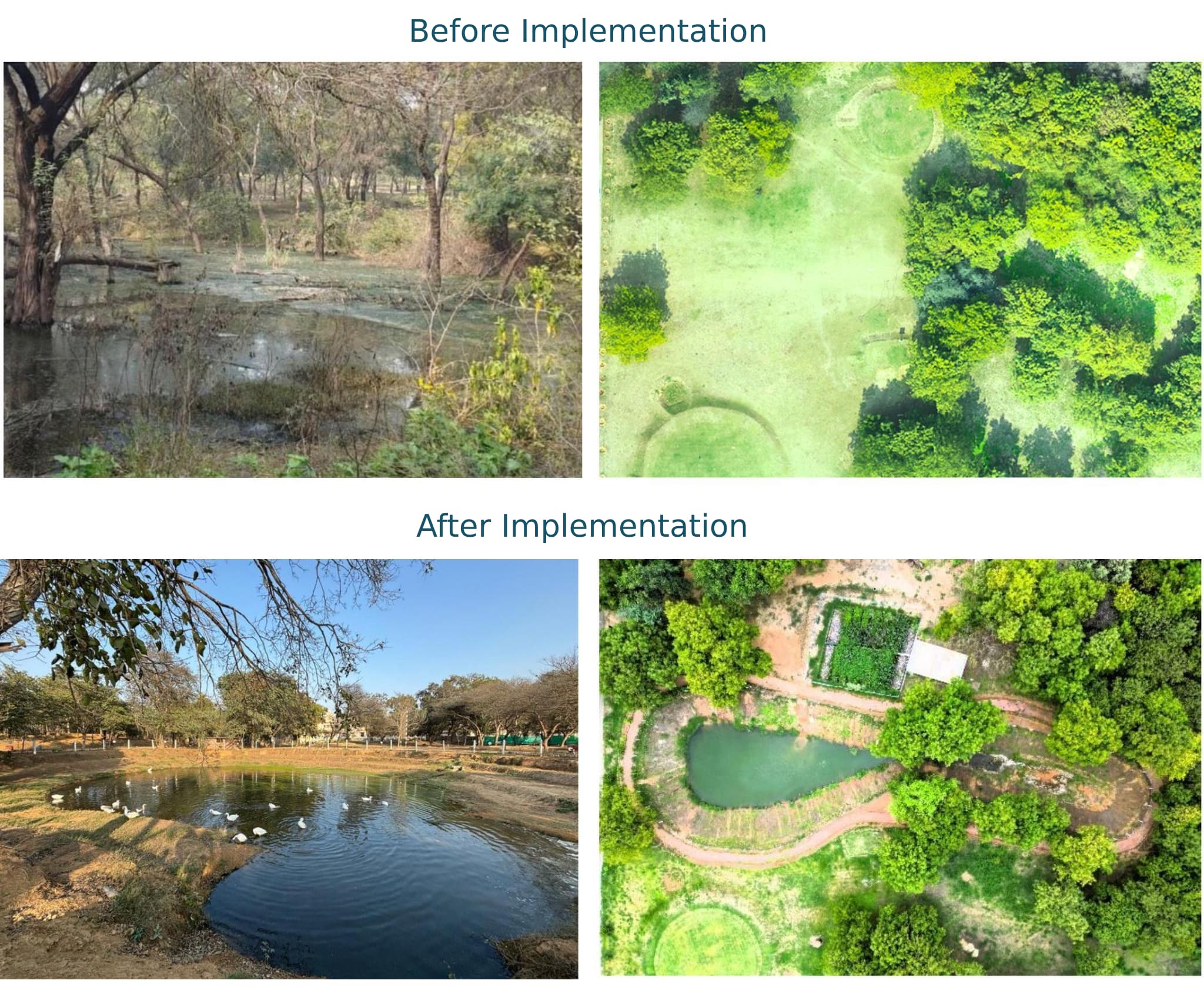
Site documentation
Before and after the pond and ABR treatment intervention
The site
A 0.5-acre pond inside an active BSF campus
The project site sits at 28.365270°N latitude and 77.056611°E longitude, inside the 95 BSF complex at Bhondsi, Gurugram. It spans 0.5 acres including a protective buffer, falls under Municipal Corporation jurisdiction and is under the guardianship of the Border Security Force.
Working inside an active institutional campus shaped every design choice — from the geometry of the embankment to the quiet, low-maintenance operation of the treatment plant. The brief was to deliver a functional treatment system and a community space, without disrupting daily life on campus.
Site at a glance
- Site
- 95 BSF, Bhondsi
- District
- Gurugram
- State
- Haryana
- Jurisdiction
- Municipal Corporation
- Guardianship
- Border Security Force
- Coordinates
- 28.365270°N, 77.056611°E
The need
Sewage pooling, a defunct plant and 116 families bearing the cost
The initial site assessment revealed sewage pooling around the manhole and a defunct 50 KLD treatment plant— once intended to handle the campus load, now non-functional. Approximately 116 families bore the daily consequences: waterlogging around quarters, mosquito breeding and a public-health risk that compounded with every monsoon.
The intervention had to do two things at once — convert the environmental hazard into a community benefit, and improve the visual and aesthetic experience of the campus so that residents had a reason to use the restored space.
Aims & objectives
Treat, recharge, transform
- Develop a resilient pond and a working treatment system to mitigate chronic sewage waterlogging at the manhole.
- Foster sustainable groundwater recharge through treated, polished effluent feeding the restored pond.
- Transform the pond and its surrounds into a community engagement and recreation sanctuary for campus families.
- Preserve and expand campus biodiversity — recorded 28 fauna species and 7 native plant species at the site.
Ecological profile
A working biodiversity baseline shaped the design
A pre-restoration survey catalogued seven native plant species and twenty-eight fauna species at the site — informing the decision to transform the surrounding expanse into a working environmental park, not just an engineered pond.
7 native plant species
Aravalli-region trees and hardy natives
- Neem
- Papdi
- Chudail Papdi
- Beriya
- Desi Keekar
- Khejdi
- Israil Babool
28 fauna species recorded
Indicator birds returning to the site
- Red-wattled Lapwing
- Green Bee-eater
- Laughing Dove
- Indian Grey Hornbill
- + 24 more
Technical interventions
Four core activities — engineered around an ABR treatment core
The Anaerobic Baffled Reactor anchors the system. The pond, paths, fencing and seating wrap around it — converting a single piece of treatment infrastructure into a usable community space.
- Activity 01
Pond Development
Full 0.5-acre excavation, embankment construction, slope stabilisation and water-retention preparation — the engineered foundation for the restored pond.
- Activity 02
50 KLD ABR WWTP
An Anaerobic Baffled Reactor — a nature-based wastewater treatment technology that purifies sewage before release into the pond, replacing the defunct plant on site.
- Activity 03
Pathways & Fencing
Brick-and-red-sand pathways and protective perimeter fencing, designed to minimise concrete use and integrate visually with the campus environment.
- Activity 04
Seating & Amenities
Community seating, dustbins and lighting — the small details that make the space usable for daily campus life, not just functional infrastructure.
Construction journey
Twelve stages, from demarcation to community seating
The construction sequence runs ABR-first — foundation, walls, slab, wetland — and then wraps the pond perimeter with paths, plantation and seating to deliver a usable community space.
- 01
Site Demarcation
Marking the pond and treatment plant boundary on the campus before excavation begins.
- 02
Pond Excavation
Excavating the 0.5-acre pond to design depth, with controlled spoil management on site.
- 03
WWTP Excavation
Excavating the footprint of the 50 KLD Anaerobic Baffled Reactor adjacent to the pond.
- 04
PCC for ABR
Laying the Plain Cement Concrete foundation that supports the ABR structure.
- 05
Reinforcement
Placing the reinforcement steel for the ABR walls before formwork and casting.
- 06
ABR Wall Construction
Building the baffled reactor walls — each chamber will sequence the anaerobic treatment.
- 07
ABR Slab Casting
Casting the top slab of the ABR — sealing the reactor and enabling planted cover above.
- 08
Gravel Bed
Laying a gravel media bed inside the wetland for plant root anchorage and biofilm growth.
- 09
Wetland Plantation
Planting the constructed-wetland species that polish the effluent before it reaches the pond.
- 10
Pathway Development
Laying the brick-and-red-sand walkways that loop the pond perimeter for community access.
- 11
Vegetation Plantation
Establishing Neem, Jamun, Amla, Jasmine and Hibiscus across the buffer zone.
- 12
Seat Placement
Installing community seating around the pond — the last step that turns the asset into a space.
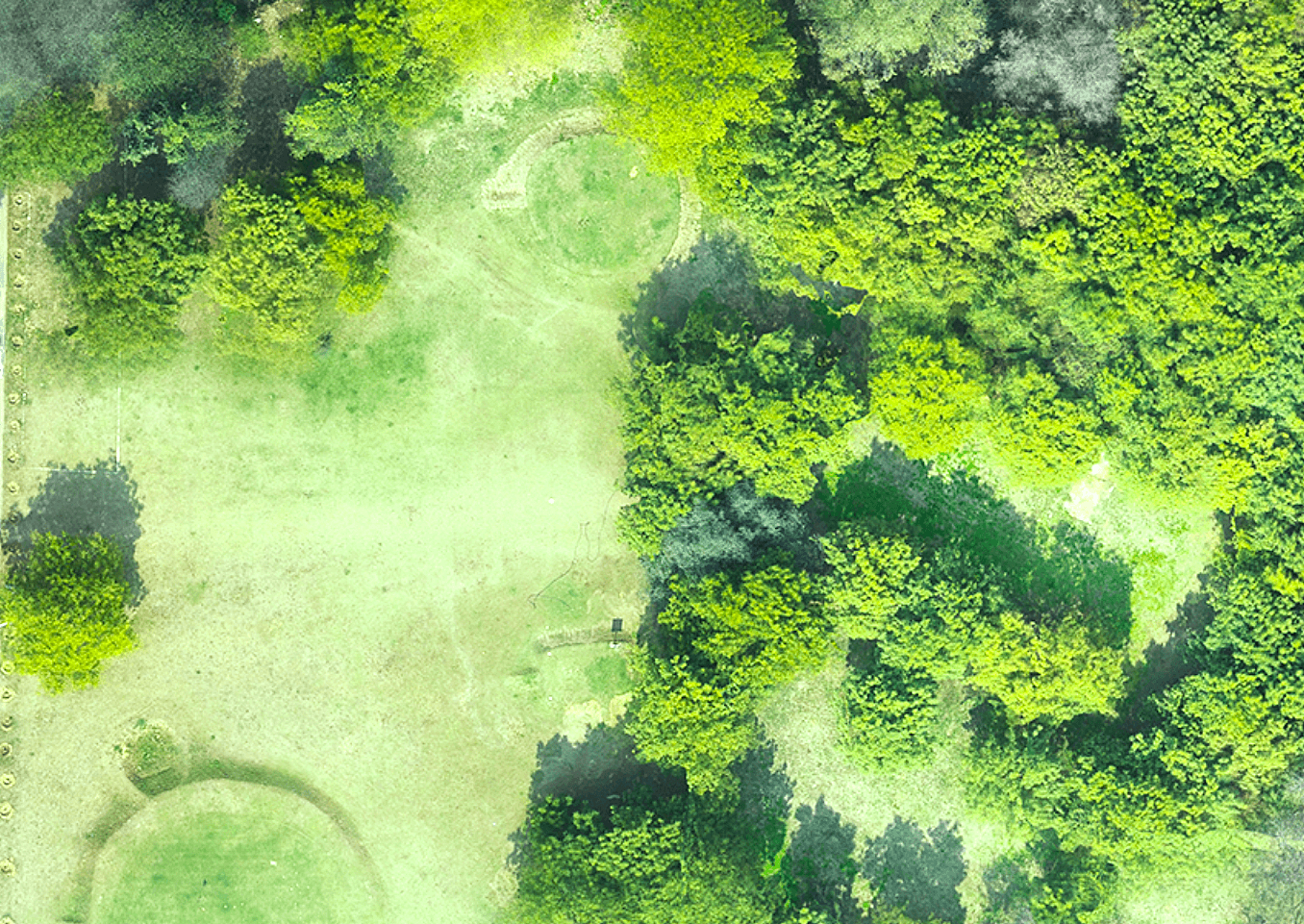 BeforeAfter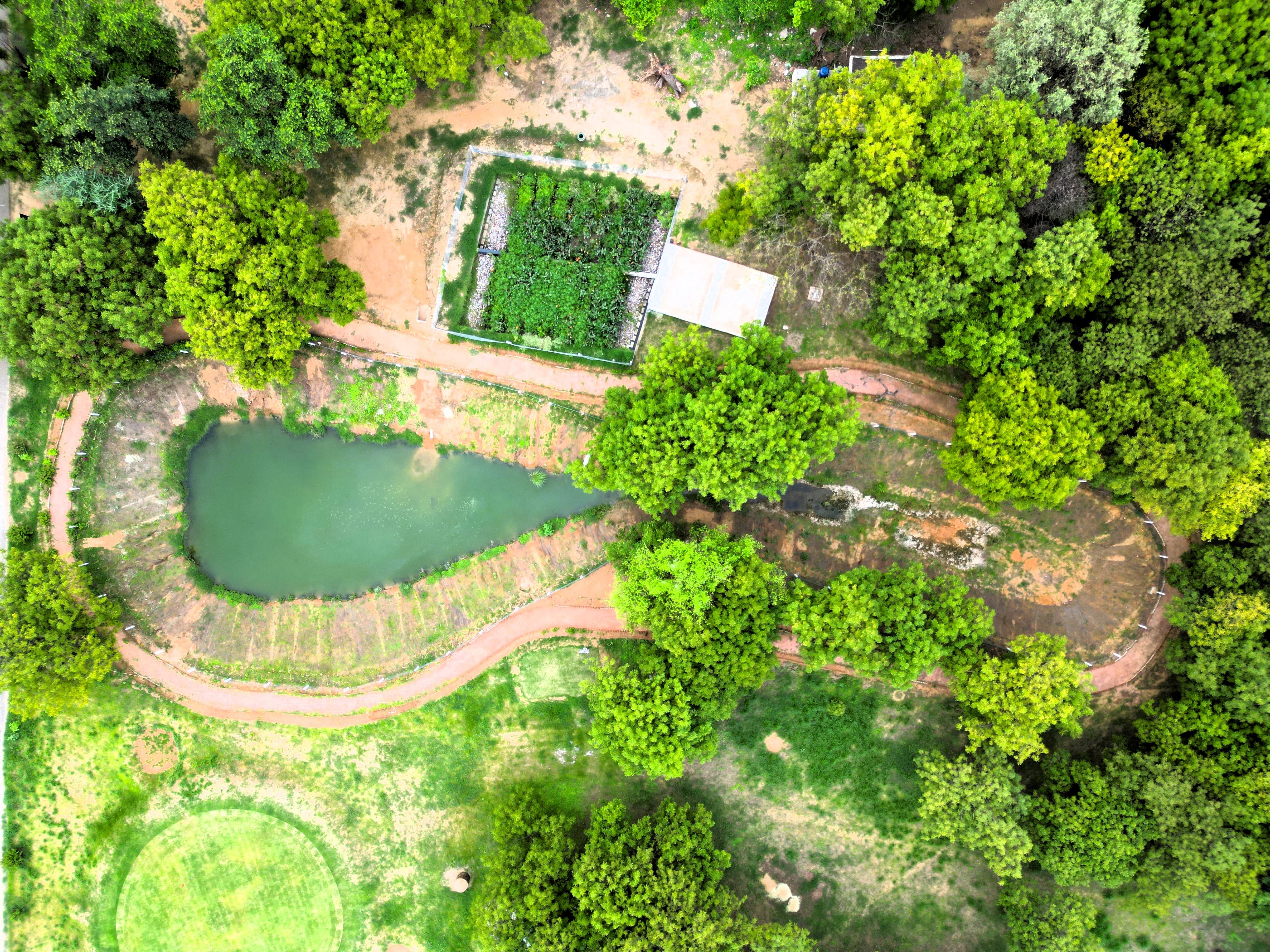
Visual vignettes
See the restoration in motion
Four short clips from the BSF Bhondsi site — the ABR treatment system in operation, the plantation, the landscaping, and the restored pond. Each clip plays automatically when it scrolls into view.
Wastewater treatment plant & wetland
A nature-based ABR purifies wastewater for the pond.
At the heart of the system, an Anaerobic Baffled Reactor (ABR) uses nature-based microbial processes to purify wastewater from the surrounding buildings before it feeds the pond — keeping the water clean and the aquifer protected.
Plantation
Native and new species enrich the pond's biodiversity.
Native species at the site were preserved untouched, and joined by new companions — Neem, Jamun, Amla, Sehtut, Tecoma, Jasmine, Hibiscus and Ficus — weaving a long-term legacy of biodiversity into the campus.
Landscaping
Brick-and-red-sand paths, no concrete around the pond.
Pathways built from bricks and red sand instead of concrete — maximising rainwater retention and reducing the heat-island effect, while creating a joyful environment around the pond.
Pond area
A tranquil reservoir that recharges the aquifer.
Placid waters that nurture diverse flora and fauna, a tranquil retreat that invites the community in, and a natural reservoir that collects rainwater and recharges the aquifer.
Information, education & communication
Building stewardship inside the campus
IEC activities centred on the jawans and the families on campus — partnering with Brookfield Properties' Employee Voluntary Program to plant trees and reframe the restored pond as a shared sanctuary.
- 01
Jawan Education Sessions
Targeted sessions for BSF jawans on water and wastewater management — operators and stewards of the new system, not just bystanders.
- 02
Rainwater Harvesting Workshops
Building practical knowledge on rainwater harvesting and solid-waste management within the campus community.
- 03
Groundwater Awareness
Underscoring the effects of groundwater depletion — connecting daily campus water use to the larger Bhondsi aquifer story.
- 04
Brookfield EVP Partnership
Brookfield Properties' Employee Voluntary Program supported tree planting and campus beautification — a corporate-community bridge.
- 05
Tree Planting Drives
Hands-on plantation by jawans and volunteers, establishing the buffer-zone canopy of Neem, Jamun and Amla.
- 06
Environmental Stewardship
Reframing the pond not as a treatment installation but as a shared campus sanctuary — to be cared for collectively.
We at GuruJal are committed to avert Day Zero while ensuring India's water security. To support us, do visit our website and explore our work.
Potential impact
From wasteland to nature sanctuary and community asset
The restoration is projected to deliver measurable ecological, hydrological and community benefits — converting a degraded campus wasteland into a working sanctuary.
- Sewage treated daily50KLD
Anaerobic Baffled Reactor replaces the defunct plant — purifying campus sewage before it reaches the pond and the aquifer.
- Relief from waterlogging116families
The pond and ABR resolve the chronic sewage pooling that affected daily life around 116 households on the BSF campus.
- Biodiversity supported28species
Twenty-eight fauna species documented at the site — including Red-wattled Lapwing, Green Bee-eater, Laughing Dove and Indian Grey Hornbill.
Help us restore the next pond
Every pond restored is a community made water secure
Support GuruJal's mission to make India water neutral — one campus, one village, one pond at a time.