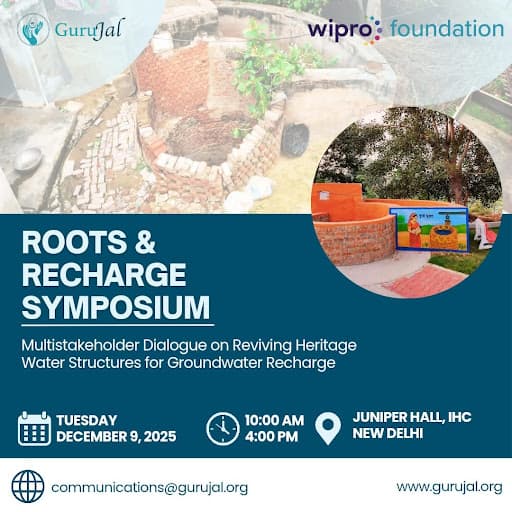
Roots & Recharge Symposium
GuruJal · Wipro Foundation · 9 December 2025 · India Habitat Centre, New Delhi
Roots & Recharge Symposium
Reviving traditional water wisdom for groundwater resilience — a multistakeholder dialogue on heritage water structures and their role in modern water planning.
- Date
- 9 Dec 2025
- Venue
- Juniper Hall, IHC
- Timings
- 10:00 AM – 4:00 PM
- Focus area
- Gurugram, Haryana
Event Overview
Reviving Heritage Water Systems for a Resilient Future
The Roots & Recharge Symposiummarked the first day of a two-day engagement on India's water future, anchored firmly in the country's traditional water wisdom. The symposium focused on one geography — Gurugram — as a lens to understand how heritage water systems, particularly dug wells, can play a critical role in contemporary groundwater resilience.
Once sustained by a dense network of traditional wells, Gurugram today reflects the pressures of rapid urbanisation and groundwater depletion. Roots & Recharge brought together policymakers, practitioners, researchers, CSR leaders and community representatives to examine how these traditional systems can be revived, governed and integrated into modern water planning.
Organised by GuruJal Society and supported by Wipro Foundation, the symposium was held on Tuesday, 9 December 2025, at Juniper Hall, India Habitat Centre, New Delhi — from 10:00 AM to 4:00 PM.
Learning from the ground
Gurugram's Dug Wells: Data & Discovery
At the heart of the symposium were findings from GuruJal's district-wide dug-well inventorisation — covering 424 dug wells across more than 200 villages in Gurugram district. The data revealed both neglect and opportunity.
- 424Wells Mapped
- 330+Inactive
- 3%RWH-Connected
- 200+Villages
Over 330 Wells Found Inactive
More than 330 of the 424 mapped wells were found inactive — abandoned, filled with waste, or facing contamination risks.
Only 3% Connected to Rainwater Harvesting
Just 3% of mapped wells were connected to rainwater harvesting systems — a critical missed opportunity.
Significant Untapped Potential
Revived wells can function as community-centric recharge assets within district-level groundwater planning frameworks.
From diagnosis to demonstration
Revival Pilots in Action
Two revival pilots in Daulatabad and Khandewla demonstrated what is possible when ecological restoration is paired with community ownership.
- Pilot 01 · Daulatabad, Gurugram
Technical Restoration & Rainwater Integration
Abandoned wells were technically restored and connected to rooftop rainwater harvesting systems, enabling rainwater to return directly to the aquifer.
Rooftop rainwater harvesting connected directly to aquifer recharge — a replicable model.
- Pilot 02 · Khandewla, Gurugram
Engineering + Cultural Revival: Kuan Poojan Ceremony
The reintroduction of a Kuan Poojan ceremony — absent for decades — transformed the well into a shared social space, reinforcing community ownership.
Cultural ceremonies reinstated alongside technical restoration build lasting community ownership.
Knowledge outputs
Enabling Replication
GuruJal launched two key knowledge resources at the symposium — designed to bridge practice, policy and replication across India.
- Standard Operating Procedure
SOP for Community-Centric Dug Well Revival
A detailed framework covering site assessment, technical restoration, rainwater integration and community stewardship — enabling any organisation to replicate the model.
Read the SOP - Coffee Table Book
Wells of Gurugram
A richly illustrated documentation of the condition, history and revival journeys of dug wells in Gurugram — capturing both data and lived community narratives.
Explore the book
Speaker line-up
Policymakers · Innovators · Practitioners
- AC
Ms. Ankita Chakravarty
Deputy Secretary, National Jal Jeevan Mission
Ministry of Jal Shakti, Government of India
- VS
Victor Shinde
Lead – Water & Environment
National Institute of Urban Affairs
- NS
Narinder Sarwan
District Development & Panchayat Officer
Gurugram
Dr. Fawzia Tarannum
Co-Founder, GuruJal
TERI School of Advanced Studies
- RP
Ravi Pahuja
CEO
Raman Kant Munjal Foundation
- AK
Archita Khanna
Sr. Communications Manager
Suntory Global Spirit of Water Programme
- PL
Pooja Lahri
Vice President
Primus Partners India
- NH
Nakul Heble
Program Manager
Wipro Foundation
- PK
Pratik Korde
Researcher
ACWADAM
- SS
Mr. Satpal Singh
Ward Councillor
Daulatabad
- KJ
Mr. Kuldeep Jangid
Sarpanch
Khandewla
Reflections from the dialogue
Voices from the Floor
The transition from Har Ghar Nal to Har Ghar Jal demands renewed attention to traditional recharge systems and community stewardship. Access is only the beginning — sustainability requires us to go deeper.
Ms. Ankita Chakravarty
Deputy Secretary, National Jal Jeevan Mission · Ministry of Jal Shakti
Open wells are living portals to aquifers. Pilots are essential — but the real challenge lies in integrating such interventions into government systems at scale.
Mr. Nakul Heble
Program Manager · Wipro Foundation
Discussions reinforced that groundwater resilience cannot be built through infrastructure alone. It requires community participation, local governance and cultural legitimacy.
Shared understanding & appreciation
What the Symposium Established
- 01
Dug Wells Are Not Relics — They Are Infrastructure
When revived thoughtfully, dug wells function as community-centric recharge assets, embedded within district-level groundwater planning. The data from 424 wells across 200 villages proved this is a scalable intervention.
- 02
Water Systems Are Also Social Systems
The revival of the Kuan Poojan ceremony was not ceremonial — it was the mechanism through which the community reclaimed ownership. Groundwater resilience requires community participation, local governance and cultural legitimacy.
- 03
Pilots Must Graduate to Policy
The SOP for Community-Centric Dug Well Revival and Wells of Gurugram were designed to close this gap — giving implementers, policymakers and district planners a shared language and a replicable model.
Event gallery
Moments from Roots & Recharge
Media coverage
In the News
Times of India
HydroMingle 2025 brings together innovators to address India's water challenges
Dainik Bhaskar
Gurugram: HydroMingle 2025 — experts from across the country gather
Times of India · Gurgaon
Experts chart roadmap to revive traditional wells in Gurugram
Amar Ujala
Roots and Recharge Seminar organised in Gurugram
Bharat Express
Gurugram groundwater crisis: GuruJal & Wipro Foundation drive dug-well revival
Continue the journey
Traditional Wisdom for a Water-Secure India
Traditional water structures — when supported by data, technical rigour, institutional alignment and community ownership — can play a vital role in India's groundwater future. The symposium laid the foundation for scaling well revival as a credible, community-anchored and replicable approach.